
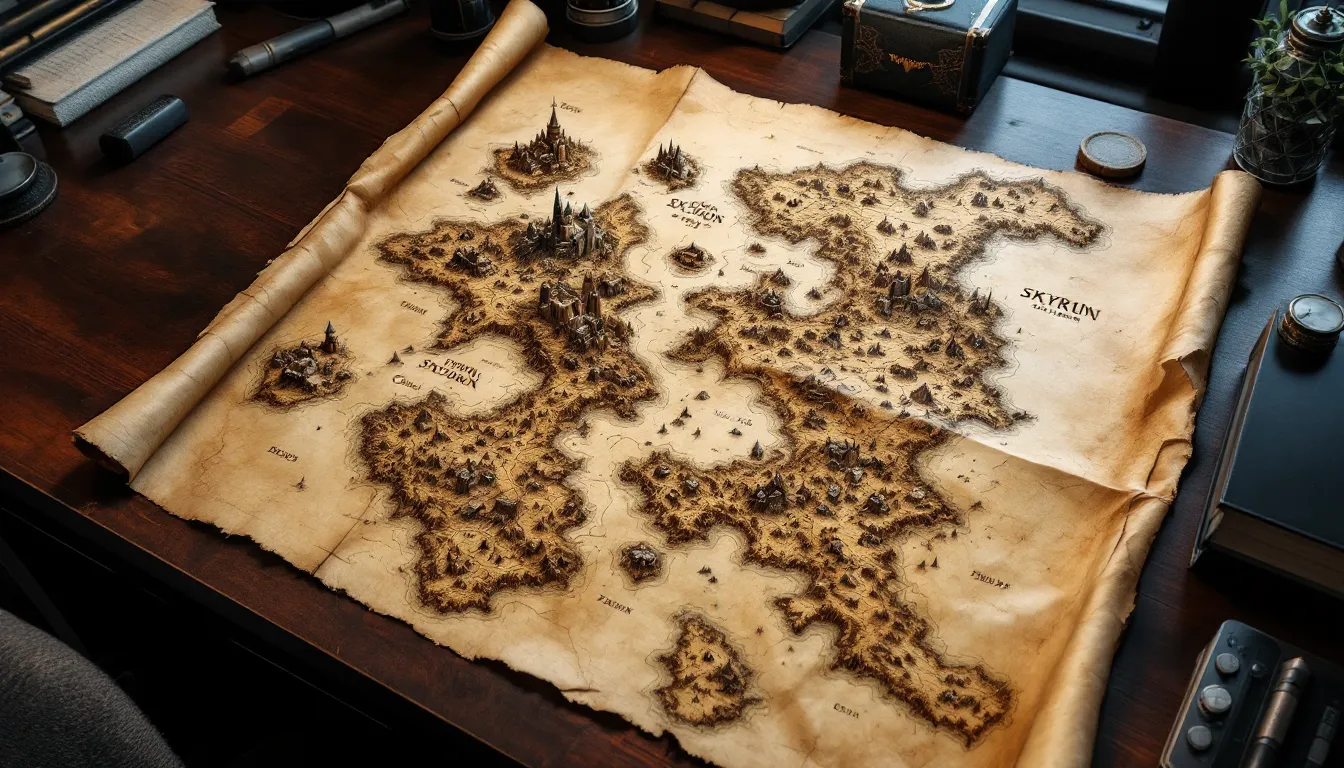
Navigating the vast expanse of Skyrim without understanding its world map is like fighting a dragon blindfolded, possible, but unnecessarily painful. The province of Skyrim sprawls across roughly 37 square kilometers of diverse terrain, from the volcanic tundra of Eastmarch to the pine forests of Falkreath Hold. Whether someone’s hunting down their hundredth playthrough or just escaped Helgen for the first time, mastering the Skyrim world map transforms aimless wandering into efficient exploration.
The in-game map system packs more functionality than many players realize, especially across the Special Edition and Anniversary Edition releases. With nine distinct holds, over 150 marked locations, and countless unmarked secrets scattered across the landscape, the map serves as more than a navigation tool, it’s the key to unlocking everything Tamriel’s frozen north has to offer. This guide breaks down everything from basic controls to DLC regions, ensuring players spend less time lost in the wilderness and more time claiming dragon souls.
Table of Contents
ToggleKey Takeaways
- Mastering the Skyrim world map transforms exploration from aimless wandering into efficient gameplay by understanding hold territories, marked locations, and the distinction between nine distinct geographic regions.
- The in-game map system features over 150 marked locations across nine holds, with additional unmarked secrets that reward thorough exploration and systematic hold-by-hold navigation.
- Fast travel in Skyrim requires physically discovering locations first, though carriages between major cities and strategic marker placement can optimize movement early in playthroughs.
- Unmarked locations scattered across the Skyrim world map provide unique rewards and environmental storytelling, making off-path exploration essential for completionist players seeking 100% discovery.
- DLC expansions add significant explorable areas including the Soul Cairn and Forgotten Vale from Dawnguard, plus the entire island of Solstheim from Dragonborn with its own 30+ marked locations.
- Interactive maps like UESP and downloadable resources allow players to plan routes, locate specific collectibles, and efficiently discover content without relying solely on the in-game interface.
Understanding the Skyrim World Map Layout
Geographic Regions and Hold Territories
Skyrim divides into nine holds, each governed by a Jarl and centered around a major city. The holds aren’t just political boundaries, they define distinct geographic and cultural zones that directly impact gameplay.
The Nine Holds:
- Haafingar (Northwest) – Solitude’s coastal territory with Imperial strongholds
- Hjaalmarch (North-Central) – Morthal’s marshlands and fog-shrouded swamps
- The Pale (North) – Dawnstar’s frozen coast and ice wraith territory
- Winterhold (Northeast) – College of Winterhold and ancient Nordic ruins
- Eastmarch (East) – Windhelm’s volcanic tundra and hot springs
- The Rift (Southeast) – Riften’s autumn forests and Thieves Guild domain
- Falkreath Hold (Southwest) – Dense pine forests bordering Cyrodiil
- Whiterun Hold (Central) – Plains and tundra surrounding Skyrim’s trading hub
- The Reach (West) – Markarth’s mountains and Forsworn camps
Each hold features unique flora, fauna, and weather patterns. The Rift’s birch forests look nothing like The Reach’s rocky canyons, making visual navigation surprisingly effective once players learn the tells. Climate shifts noticeably when crossing hold boundaries, stepping from Falkreath’s relatively mild forests into The Reach’s harsh mountains demonstrates Skyrim’s environmental variety.
Key Landmarks and Points of Interest
The map icons system categorizes over 340 discoverable locations across the base game. Understanding these markers prevents wasted trips and helps prioritize exploration routes.
Primary Icon Categories:
- Cities (9 walled settlements) – Marked with large icons, these serve as quest hubs and fast travel anchors
- Towns/Villages (Small settlements) – Places like Riverwood, Rorikstead, and Ivarstead
- Camps (Bandit/Forsworn/Giant) – Marked once discovered, respawn after 30 in-game days
- Dungeons (Caves, ruins, forts) – Over 150 instanced locations with unique loot
- Dragon Lairs – Word Wall locations marked after discovery
- Standing Stones (13 total) – Permanent buff locations scattered across holds
- Dwemer Ruins – Distinct architecture, typically containing Falmer and automatons
The Throat of the World dominates central Skyrim at 766.5 meters, making it visible from most holds. This snow-capped peak serves as a natural compass point, if it’s to the north, the player’s in the southern holds. Other notable landmarks include High Hrothgar on the mountain’s slopes, the College of Winterhold perched on its cliff, and Bleak Falls Barrow overlooking Riverwood.
How to Access and Use the In-Game Map
Map Controls and Navigation Features
Accessing the map varies by platform but remains straightforward across all versions. On PC, tapping M opens the world map (or Tab for the full menu, then selecting Map). Console players press the designated menu button, Start/Options on PlayStation, Menu on Xbox.
The map interface offers several zoom levels controlled by mouse wheel on PC or trigger buttons on controllers. Close zoom reveals terrain details and path routes, while maximum zoom-out displays the entire province. Cloud coverage obscures unexplored areas, clearing only after the player physically visits those regions.
Navigation Controls by Platform:
- PC: Left-click and drag to pan, mouse wheel to zoom, right-click on discovered locations to set active quest marker
- PlayStation: Left stick pans, L2/R2 zoom, X button selects locations, Square sets custom markers
- Xbox: Left stick pans, LT/RT zoom, A button selects, X sets markers
The local map (accessed while in dungeons or cities) switches to a top-down floor plan showing interior layouts. This view proves essential for multi-level dungeons like Blackreach or Mzulft, where vertical navigation can confuse even veteran players. The local map displays doors, quest objectives, and previously visited chambers in distinct coloring.
Different map markers provide distinct information. Quest markers display as diamond shapes (hollow for inactive quests, filled for active ones). Location icons remain black until discovered, then turn white. The player position appears as a white arrow indicating facing direction, critical for aligning movement with map orientation.
Setting Custom Markers and Waypoints
Custom markers let players tag points of interest before formal discovery. This feature, available since the original release, often gets overlooked but dramatically improves exploration efficiency for completionist players.
To place a marker, open the map and select any visible location. The interface displays available options: Set Objective creates a quest-style marker, while Place Marker (available on visible but undiscovered locations) adds a custom waypoint. Only one custom marker can exist at a time, placing a new one removes the previous tag.
The compass at the top of the HUD displays custom markers as white diamonds, distinct from quest markers (typically hollow or filled depending on objective status). Distance to marked locations appears when players face that direction, updating dynamically as they move.
Practical Marker Applications:
- Tagging resource-rich areas spotted while over-encumbered
- Marking suspicious locations lacking map icons (potential unmarked content)
- Planning efficient routes between multiple objectives
- Remembering dragon burial mounds before they activate
- Noting ore vein clusters for smithing material runs
Markers persist through save/load cycles and even remain after fast traveling away. They don’t, but, survive between different characters, each playthrough starts with a fresh marker slate.
Major Cities and Capital Holds
Whiterun, Solitude, and Windhelm
Three cities dominate Skyrim’s political and geographic landscape, each serving as a crucial hub in most playthroughs.
Whiterun sits dead center on the map, making it the most accessible city from any direction. Its position at the convergence of multiple holds makes it the natural first major city for players following the main quest from Riverwood. The city sprawls across three distinct tiers, the Plains District (lower market), the Wind District (middle residential), and the Cloud District (Dragonsreach and upper estates). Whiterun serves as the primary questline anchor through the Jarl’s court and houses essential merchants like Adrianne Avenicci (blacksmith) and Belethor’s General Goods.
Solitude occupies the northwestern corner in Haafingar Hold, perched on a natural stone arch above the Sea of Ghosts. As the Imperial capital of Skyrim, it houses the Bards College, the headquarters of the Imperial Legion, and arguably the best selection of merchants in the province. The Blue Palace dominates the cityscape, while the Winking Skeever provides one of the more convenient inn locations. Solitude’s position makes it ideal for accessing the western holds and Morthal’s swamps.
Windhelm anchors the eastern region in Eastmarch, serving as Stormcloak territory and home to Ulfric Stormcloak. The oldest human city in Tamriel features distinctive Nordic architecture and the Snow Quarter segregating Dunmer residents. The Palace of the Kings houses key Civil War questlines, while the city’s position provides access to the Winterhold region and eastern wilderness. The city’s harsh climate matches its political tensions, temperatures here regularly drop below freezing.
Each capital offers unique advantages. Whiterun provides central access, Solitude grants superior shopping options, and Windhelm offers proximity to high-level eastern dungeons and the path to Solstheim (with Dragonborn DLC).
Smaller Holds Worth Exploring
Four additional walled cities round out Skyrim’s urban centers, each offering distinct flavors and questlines that many casual players skip.
Markarth in The Reach presents the most architecturally unique city, carved entirely from Dwemer ruins with waterfalls cascading through districts. The city harbors the Forsworn Conspiracy questline, Cidhna Mine, and Understone Keep. Its western position makes it slightly isolated but grants access to numerous Dwemer ruins and Forsworn camps. The Silver-Blood family’s influence permeates every corner, creating one of Skyrim’s more morally complex political situations.
Riften occupies the southeastern corner of The Rift, built on stilts over Lake Honrich. This city serves as the Thieves Guild headquarters (accessed through the Ratway) and houses Maven Black-Briar’s criminal empire. The market square provides easy access to the fishery, Honeyside (a purchasable home), and the Temple of Mara. Riften’s corruption makes it narratively compelling but mechanically frustrating, guards regularly shake down players for “protection” money.
Morthal in Hjaalmarch Hold barely qualifies as a city, it’s more an oversized village shrouded in perpetual fog. The settlement serves as the starting point for the “Laid to Rest” quest and provides access to the swampland’s numerous alchemy ingredients. Its small size actually makes it efficient for quick merchant runs and the nearby guardian stone cluster.
Dawnstar on the northern coast features the Dark Brotherhood sanctuary (after completing their questline) and serves as a maritime trading post. The city’s most famous feature is the invisible Khajiit merchant chest glitch, where certain techniques allow access to merchant inventories without proper trading. The museum exhibit in the Jarl’s longhouse becomes relevant during the “Pieces of the Past” Daedric quest.
Winterhold deserves mention even though its diminished state, the Great Collapse destroyed most of the ancient capital, leaving only the College and a handful of buildings clinging to the cliff edge. The College itself functions as a city substitute for mage-focused characters.
Dungeons, Caves, and Hidden Locations
Dragon Lairs and Word Walls
Dragon lairs represent some of Skyrim’s most rewarding map locations, combining combat challenges with permanent character progression through Word Walls. The game includes 23 dragon lair locations, though not all are immediately hostile.
Each dragon lair features a Word Wall, ancient structures teaching words of power for dragon shouts. The walls themselves display draconic script that translates when approached, automatically granting one word from a specific shout. Collecting all three words of a shout (spread across different locations) unlocks its full potential, though each word requires dragon soul absorption to activate.
Notable Dragon Lair Locations:
- Shearpoint (Northeast of Fellglow Keep) – Contains the powerful dragon Krosis and his eponymous Dragon Priest mask
- Ancient’s Ascent (Southwest of Morthal) – Throw Voice shout, useful for distraction tactics
- Bonestrewn Crest (North of Kjenstag Ruins) – Frost Breath word, elevated position
- Mount Anthor (Northwest of Windhelm) – Story-required location during College questline
- Dragontooth Crater (Northwest of Karthwasten) – Elemental Fury shout word
- Northwind Summit (South of Riften) – Aura Whisper shout, excellent for stealth builds
Dragons at their lairs don’t spawn until players reach certain main quest milestones, specifically after the “Dragon Rising” quest at the Western Watchtower. Before this trigger, Word Walls at dragon lairs can be claimed without combat. Strategic players often rush these locations early for free shout words.
Some lairs feature resurrection points where dragons respawn after death (typically 10 in-game days). These provide renewable dragon soul sources for players hunting shout activations. The random dragon encounter system supplements these fixed locations, dragons can attack players anywhere in the overworld once the main quest progresses far enough.
Unmarked Locations and Secret Areas
Unmarked locations represent Skyrim’s deepest secrets, places without map icons that reward thorough exploration. The game contains over 150 unmarked points of interest ranging from minor resource caches to substantial hidden questlines.
Significant Unmarked Discoveries:
The Headless Horseman appears at night near Hamvir’s Rest, riding toward various locations. Following him leads to discoverable graveyards and occasionally triggers unique encounters. He’s purely atmospheric, no combat or loot involved, but remains one of Skyrim’s most memorable unmarked features.
Kagrenzel presents one of the most dramatic unmarked entrances. This Dwemer ruin in the mountains east of Mzulft features a seemingly empty chamber with a mysterious orb. Approaching the orb triggers a trapdoor, sending players plummeting down a massive waterfall shaft into underground passages. Surviving the fall (landing in water) grants access to a unique Dwemer passage leading to Stony Creek Cave.
The Lunar Forge sits atop Silent Moons Camp, northwest of Whiterun. This unique blacksmith station allows crafting of Lunar weapons, iron and steel equipment with bonus damage during nighttime hours. The forge doesn’t appear on the map as distinct from the camp itself, making it easy to miss.
Meeko’s Shack contains the deceased owner and Meeko, a dog follower available for recruitment. This small cabin northwest of Morthal offers one of the earliest permanent animal companions but lacks any map indicator.
Ilas-Tei’s Camp near the Windhelm docks shows the aftermath of a deadly encounter, with environmental storytelling revealing the fate of a hunter. These small scenes scatter across Skyrim, rewarding observant explorers with unique items and implied narratives.
Shrouded Grove in the southeastern Rift appears as a small pond surrounded by unique glowing yellow flowers. The location serves no quest purpose but demonstrates Bethesda’s environmental detail work. Many experienced players hunt these aesthetic locations for screenshots.
Resource-focused players hunt unmarked ore veins, mushroom clusters, and alchemy gardens that don’t trigger map updates but provide valuable materials. The game’s design philosophy scattered these rewards deliberately, fast traveling between marked locations skips substantial content. Walking between objectives often reveals two or three unmarked discoveries per journey.
Fast Travel System and How It Works
Unlocking Fast Travel Points
Fast travel in Skyrim operates on a discovery-based system, players must physically visit locations before warping to them later. The mechanic fundamentally changes how efficiently anyone can navigate the province once they’ve put in the initial legwork.
Any discovered location marked on the map becomes a fast travel destination. This includes cities, towns, villages, dragon lairs, dungeons, camps, and even some unmarked locations that trigger automatic discovery (like certain Daedric shrines). The white coloring on map icons confirms fast travel availability, black icons indicate places heard about but not personally visited.
Activating fast travel requires opening the map and selecting the destination marker. The screen fades to black with a loading screen, then deposits players at the location’s entrance. Time advances during fast travel, the duration depends on distance traveled, averaging about 1 hour of in-game time per map grid square. This time passage can affect time-sensitive quests or trigger random encounters upon arrival.
Fast Travel Optimization Strategies:
- Complete the initial exploration phase systematically, visiting all marked locations in each hold before moving on
- Unlock carriages in major cities (5-25 gold per trip) for instant travel between capitals before discovering them naturally
- Place camps using survival mechanics (Anniversary Edition) to create custom fast travel points in strategic locations
- Prioritize unlocking Guardian Stones and other permanent buff locations for quick access when respeccing
Carriages outside major cities (Whiterun, Solitude, Riften, Markarth, Windhelm) provide fast travel to other cities even before discovering them on foot. These cost 20-50 gold depending on distance but save considerable walking time early in playthroughs. The carriage system won’t transport players to dungeons or wilderness locations, only city gates.
When Fast Travel Is Disabled
Certain conditions completely disable fast travel, forcing players to walk regardless of previously discovered locations. Understanding these restrictions prevents frustrating surprises during crucial moments.
Fast Travel Restrictions:
- Combat – Any enemy awareness (red combat indicator) prevents fast travel. This includes nearby enemies that haven’t engaged but can detect the player. The game must return to “normal” status (white compass) before the map allows travel.
- Guard awareness – Having a bounty with approaching guards blocks travel. Players must resolve the bounty (pay/serve time/resist arrest) before traveling.
- Trespassing – Being in restricted areas (red “Trespassing” text) disables fast travel until the player leaves or area ownership changes.
- Over-encumbered – Carrying too much weight (exceeding carry capacity) prevents movement, including fast travel. Drop items or use strength-boosting effects to resolve.
- Survival Mode (Anniversary Edition optional feature) – This difficulty mode removes fast travel entirely except via carriage, forcing manual navigation and increasing immersion/challenge.
Dungeon interiors present a special case, players can fast travel from dungeon entrances but not from deep within instanced locations. Most dungeons feature alternative exits near their end, providing shortcuts back to the surface rather than backtracking through cleared areas. The game’s design philosophy encourages one-way dungeon progression with exit-near-end architecture.
Certain quest stages temporarily disable fast travel for narrative purposes. The “Diplomatic Immunity” quest locks travel while infiltrating the Thalmor Embassy. The main quest’s “Alduin’s Bane” restricts travel during specific sequences. These restrictions lift automatically once the relevant quest stages complete.
Players who’ve grown frustrated by fast travel restrictions sometimes turn to console commands (PC) or specific modding solutions that override these limitations. The trade-off typically involves reduced immersion and occasional quest-breaking bugs if travel occurs during scripted sequences.
DLC Expansions and Additional Map Areas
Dawnguard and Dragonborn Map Additions
Dawnguard introduces several new map areas focusing on vampire and vampire hunter content. The most significant addition is the Soul Cairn, an entire plane of Oblivion accessible during the questline. This realm presents as a vast purple wasteland filled with soul-trapped entities, unique loot, and the Bone Hawk mount. The Soul Cairn operates as a separate map zone with its own fast travel points and discoverable locations.
Castle Volkihar serves as the vampire faction headquarters on an island northwest of Solitude (though not directly visible on the main map until accessed via quest). The castle’s gothic architecture and interior dungeons provide a substantial new explorable space. Similarly, Fort Dawnguard in the southeastern Rift (Dayspring Canyon) houses the vampire hunters and opens after starting the DLC questline.
The Forgotten Vale represents Dawnguard’s most expansive area, a massive hidden valley containing unique flora, fauna, and five Wayshrines forming a pilgrimage route. This zone connects multiple interior and exterior cells, rivaling some holds in total explorable space. The Vale hides behind the Darkfall Cave entrance and doesn’t appear on the standard world map, requiring internal navigation using the local map system.
Dragonborn adds the entire island of Solstheim as a separate world space comparable in size to Skyrim’s largest holds. This island, previously featured in the Bloodmoon expansion for Morrowind, underwent volcanic devastation between games. The southern ash wastes contrast dramatically with the northern forests, creating diverse environments.
Solstheim’s map includes several major locations: Raven Rock (the primary settlement), Tel Mithryn (Telvanni wizard tower), Skaal Village (Nord tribal community), and Fort Frostmoth (Imperial ruins). The island contains over 30 marked locations plus numerous unmarked sites. The massive Apocrypha realm, Hermaeus Mora’s plane of Oblivion, expands the explorable area further with its otherworldly libraries and tentacled horrors.
How to Access DLC Regions
Accessing DLC areas requires meeting specific triggers and following particular travel methods, the game doesn’t immediately unlock these zones after installing the expansions.
Dawnguard Access:
Reaching level 10 triggers a guard dialogue or courier delivery mentioning vampire attacks. This starts “Dawnguard,” directing players to either Fort Dawnguard (Dayspring Canyon southeast of Riften) or Castle Volkihar (quest-dependent). The Fort requires walking to the canyon entrance, no fast travel until discovered. Castle Volkihar becomes accessible via boat during the “Bloodline” quest.
The Forgotten Vale requires progression through the questline until “Touching the Sky.” Entrance via Darkfall Cave (near Markarth) only opens during this quest, making it impossible to access beforehand. The Soul Cairn unlocks during “Beyond Death” or “Chasing Echoes” depending on faction choice.
Dragonborn Access:
Installing Dragonborn triggers cultist attacks once players complete “The Horn of Jurgen Windcaller” (early main quest). Reading the note on their bodies starts “Dragonborn,” directing players to Windhelm’s docks. Speaking to Gjalund Salt-Sage at the Shatter-Shield office initiates boat travel to Raven Rock, this becomes the permanent travel method between Skyrim and Solstheim.
Once on Solstheim, fast travel between discovered island locations works normally. Returning to Skyrim requires returning to Raven Rock and hiring the boat again (no cost after initial payment), though some players report frustration with this backtracking requirement during multi-zone quests.
Apocrypha access occurs during specific Black Book readings scattered throughout Solstheim. These daedric artifacts serve as portals to separate Apocrypha zones, each designed as a self-contained challenge area with unique rewards. Players can return to Skyrim/Solstheim from Apocrypha by reading the exit book at each zone’s conclusion.
Interactive and Printable Map Resources
Best Online Interactive Maps for Skyrim
Interactive web-based maps revolutionize Skyrim navigation by providing searchable databases of every location, collectible, and quest trigger. These tools let players plan routes, hunt specific items, and identify missed content without memorizing hundreds of map coordinates.
UESP (Unofficial Elder Scrolls Pages) Interactive Map stands as the community gold standard. This open-source project catalogs every location with categories for dungeons, cities, camps, landmarks, and more. Users can toggle specific location types, search by name, and click markers for detailed information including enemies, loot, and related quests. The UESP map includes base game and all DLC content with separate layer options.
The map displays coordinates, making it invaluable for PC players using console commands to teleport. Each location entry links to comprehensive wiki pages with walkthroughs, NPC details, and historical lore. The tool’s only weakness is its dated interface, functionality trumps aesthetics, but navigation requires some adjustment for mobile users.
Game8’s Skyrim Map provides a more modern UI with refined filtering options. This tool excels at quest tracking, allowing players to filter locations by associated questlines. The visual design uses color-coded markers and smooth zoom transitions. But, their database focuses primarily on quest-related content, sometimes omitting unmarked locations that UESP catalogs.
IGN’s Interactive Map offers middle-ground complexity, more detailed than casual guides but less exhaustive than UESP. The strength here lies in screenshot integration and curated routes. IGN includes suggested exploration paths for specific builds or quest types. The advertising-heavy interface frustrates some users, but the content quality remains solid for most purposes.
For players seeking completion percentages, several community-developed checklist tools integrate with these maps. These track discovered locations, collected items, and completed objectives across saves, proving essential for 100% completion runs.
Downloadable and Printable Map Options
Physical and downloadable maps serve players who prefer reference materials outside the game or want wall decorations showcasing Skyrim’s geography.
The official strategy guide maps (originally from Prima Games, now out of print) provided high-resolution poster versions showing all holds, major roads, and city locations. These physical maps occasionally appear on resale markets (eBay, Mercari) typically priced between $20-$50 depending on condition. The cartography style matches in-game aesthetics with aged parchment textures and stylized mountain illustrations.
Bethesda’s official website historically offered free downloadable maps as PDF files during Skyrim’s initial release window. These files still circulate on community forums and fan sites. The PDFs include separate pages for each hold at high resolution suitable for printing at poster sizes (24×36 inches at 300 DPI).
Fan-Created Topographic Maps elevate cartography beyond simple location markers. Several community artists created geographically accurate height-map versions showing actual terrain elevation, water features, and accurate road networks. These maps appeal to players interested in realistic navigation and immersive roleplaying. The most popular versions use color gradients to indicate elevation changes, making mountain passes and valley routes immediately apparent.
For practical use, several community members maintain updated PDF compilations including:
- Full province maps with all discoverable locations marked
- Individual hold maps with roads, dungeons, and resource nodes
- City floor plans showing interior layouts for major settlements
- Annotated maps highlighting specific collectibles (Dragon Claws, Stones of Barenziah, Unusual Gems)
These files typically circulate through Reddit’s r/skyrim community, Nexus Mods forums, and dedicated fan sites. Quality varies, some are simple screenshots with added markers, while others are professional-grade redesigns rivaling official materials.
Print-on-demand services let players order custom Skyrim maps on canvas, metal prints, or traditional poster paper. Etsy hosts numerous sellers offering these services, with prices ranging from $15-$100 depending on size and material. Copyright considerations mean these are technically gray-market products, though Bethesda hasn’t actively pursued sellers.
For digital second-screen use, several mobile apps replicate interactive map functionality. “Skyrim Map” on iOS and “The Guide for Skyrim” on Android provide offline access to location databases, useful when gaming on systems without easy alt-tab functionality.
Tips for Efficient Map Exploration
Efficient exploration means maximizing discovery while minimizing wasted time backtracking or wandering without purpose. The following strategies separate completionists from casual wanderers.
Systematic Hold Clearing beats random exploration for completion-focused players. Pick a hold, visit every marked location on the map, then move to an adjacent territory. This method ensures comprehensive coverage and reveals the highest percentage of unmarked locations (which tend to cluster near marked sites). Starting with Whiterun Hold makes sense given its central position and relatively safe low-level content.
Follow the roads initially. Skyrim’s road network connects all major locations and typically passes near points of interest. Roads also reduce encounters with high-level predators (sabrecats, bears) that spawn more frequently in deep wilderness. Once comfortable with combat mechanics and map layout, cutting cross-country saves time but increases risk.
Climb mountains strategically. The mountainous terrain naturally channels movement, but experienced players learn climbing routes that bypass hours of walking around peaks. Horses make climbing trivial, their physics allow scaling near-vertical slopes. Shadowmere (Dark Brotherhood reward) and Arvak (Dawnguard spectral horse) provide permanent climbing solutions for players who’ve completed those questlines.
Weather and time affect navigation. Snowstorms in northern holds reduce visibility to near-zero, making navigation by landmarks impossible. The compass remains functional, but many players report getting disoriented during whiteouts. Similarly, nighttime exploration without lighting or night vision makes spotting unmarked locations significantly harder. Khajiit or vampire characters gain night vision benefits that partially mitigate this.
Use followers as pack mules for extended trips. Every follower has carry capacity exceeding most player builds early-game. Load them with supplies and loot before long exploration sessions, reducing the need to return to cities for inventory management. Unlimited arrow followers (like Aela) provide additional combat support without resource drain.
Quest markers guide efficient routing. Accepting multiple quests in the same region before departing creates natural waypoints. The game’s radiant quest system often directs players to unvisited dungeons, making these otherwise generic fetch quests serve double duty as exploration motivators. Just avoid completing the quests immediately, let them stack until efficient routes emerge.
Alchemy runs combine well with exploration. The most valuable ingredients (Deathbell, Mountain Flowers, Imp Stool) grow along travel routes. Harvesting while traveling generates passive income and levels alchemy without dedicated farming sessions. Similarly, mining ore veins encountered during exploration fills smithing material needs.
Use Clairvoyance for confusing terrain. This apprentice-level Illusion spell creates a path leading to active quest markers. While not essential in open terrain, it proves invaluable in dense forests, mountainous regions, or when seeking specific cave entrances. The spell costs minimal magicka and works even for non-mage builds.
Check cleared locations after respawn timers. Most dungeons respawn after 10-30 in-game days (location dependent). Revisiting cleared sites provides renewable loot and experience without the discovery-based navigation time. Marking recently cleared locations on the map helps track respawn eligibility for efficient farming runs.
Conclusion
The Skyrim world map transforms from overwhelming to indispensable once players master its systems. Understanding hold territories, efficiently unlocking fast travel points, and recognizing the distinction between marked and unmarked content separates aimless wandering from purposeful exploration. The map isn’t just a navigation tool, it’s the key to experiencing everything Bethesda packed into Tamriel’s northern province.
Whether someone’s hunting their hundredth dragon or just discovering their first Word Wall, the strategies covered here apply across all playstyles. From DLC regions expanding the available territory to interactive online resources supplementing the in-game interface, players have more tools than ever for conquering Skyrim’s geography. The frozen north holds hundreds of hours of content for those willing to venture beyond the next quest marker and see what lies in that unmarked cave on the hillside.